MØMCX

Amateur Radio Operator


The M0XXT Mega-Loop antenna - VHF gain for the HF bands

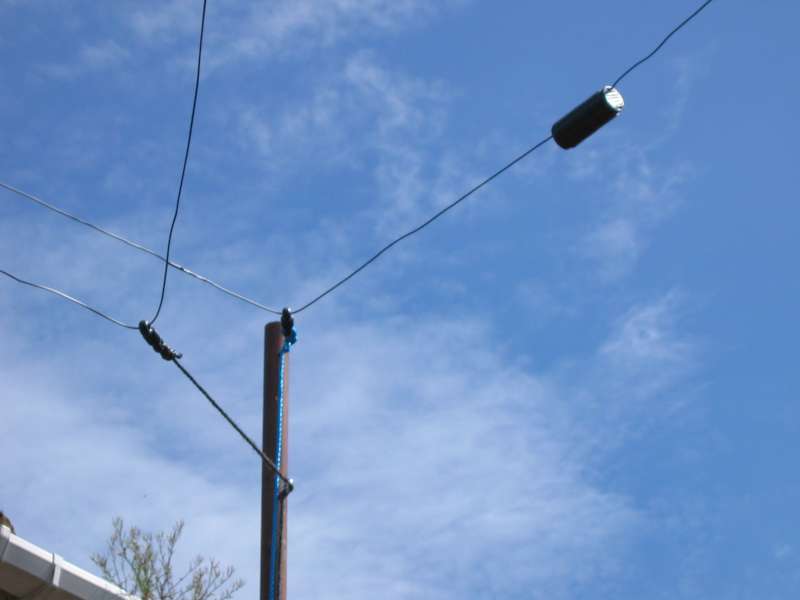
Many people ask me what our HF antenna is. It’s just a delta loop antenna (triangle) made from 2mm wire at about 58m per leg (174m perimeter) with a height above ground of around 60 to 80 feet (depending on tension) fed with coax to a 4:1 balun at the feedpoint in one corner. It is horizontal and strung between three large oak trees. The main RF gain is opposite the feedpoint. We achieve less than 2:1 across most of the ham bands. It even works for WARC bands too.
Over the last two years, we have had huge success with this antenna which tunes from 160m band right up to 6m (we’ve even used it on 2m and 70cms!). Originally, this design was for 80m perimeter but we extended it to twice the size on a whim and it worked even better. The plots that follow are now inaccurate. These are extremely conservative. Doubling the size makes the 20m plot look more like the 10m plot now.Go check the last picture below. It says 10m band but this is what we’re actually achieving on 20m. Isn’t that amazing? 10m is off the scale with less than 5% take-off angles.
I have held a pile up from Birmingham (UK) to West Coast of USA on 10w. Receiving 57 reports at that power. Running 400w delivers consistend 20dB over S9 reports in early eve, winter time.

XXT loop

20m loop

15m

10m XXT Loop

March 21st, 2011 Posted by admin | Amateur Radio | no comments

Power Over Ethernet - Buffalo G54 - WiFi Antenna

POEI found my old article recently regarding my home-brew Power Over Ethernet Project. James and will shortly be putting internet at the Scout Hut around one mile away and having my router as close to the antennas as possible will be mandatory. Here’s an old project that I wrote up in 2009:

Using very high quality coax from my vertical antenna to a router in the shack is a very expensive option due to the very high losses at 2.4 GHz. We could use Ecoflex 15, but at £6 per meter and £9 for a connector, it’s a bit rich for a kids experiement.
Better bet is to site the router on top of the mast right next to the antenna in a waterproof box, using just a tiny pig-tail of coax from the antenna directly to the router. Of course, you need power to the router which might mean sending 240v utility power up the mast to the little PSU that comes with the router. Not a good option, having mains dripping off a mast.

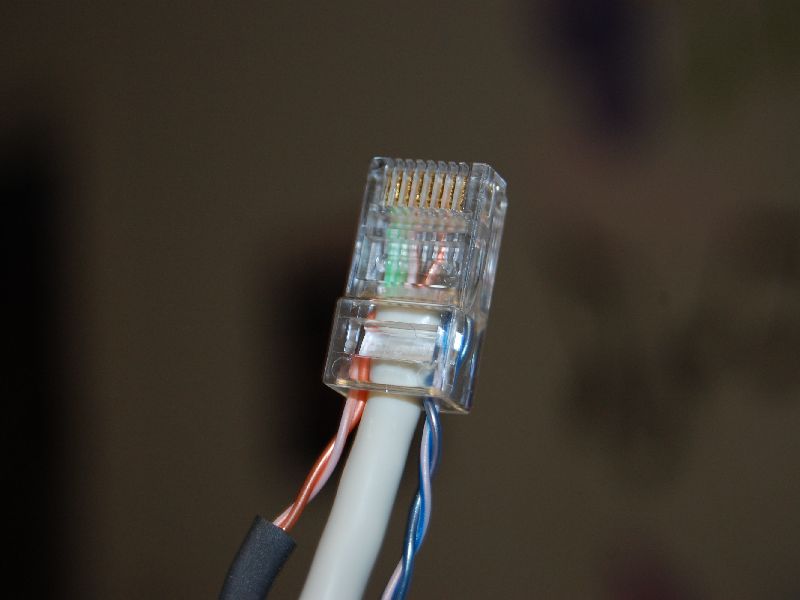
How about cutting the low voltage line from the router’s PSU and extending it so that you have just DC running up the mast instead of mains? You can, but why not use the spare data pairs in the CAT 5 spec instead. These are pins 4 & 5 and 7 & 8. Connect the pairs together to lower the resistance (Ohms Law).

Power Over Ethernet Buffalo G54Ignore the colours that I have used in my project, this was to make fault finding easy in the future; blue being the negative and orange for positive - although in typical amateur radio style, I got these muddled up so now they’re the wrong way around and I wish I had just used the normal colours for the data now! Grrr.

Cat 5 Wiring DiagramI made up a 20 meter run of Cat 5 and injected 3.3 V DC from the little PSU that came with the router and pulled it out at the router end, as per the picture. Initially it failed miserably since the voltage drop was too low. The PSU was rated at 3.3V DC and 2A. Essentially, once the Router tried to suck any power down the line, the voltage dropped like a stone and the router wouldn’t boot up.

Throwing caution to the wind, I cut the 3.3V PSU off and substituted a 7V DC PSU which was lying about. My multimeter is currently on the boat, so I just did some rough mental calculations and guessed that the voltage would drop by around half, giving me maybe about 3.5 to 4 volts. Hopefully tolerable by a modern 3.3V device. I’ll measure it sometime, under load as well as no-load conditions.

Second caution to the wind was that when I cut the 7V cable off the donated PSU, I realised that the wires on the new device were not marked. I had no idea which was positive and which was negative. Not having a spare multimeter, I just hoped that getting the negative and positive the wrong way around wouldn’t concrete the damned thing. Luckily, Buffalo G54’s are two-a-penny these days on eBay and all my 2.4 GHz wireless experiments use these excellent devices. It wouldn’t be the first time that I had bricked one. Luck was in my favour tonight though and it all booted up just fine. Lucky or what?!
To sum up, if you are to do this, use pins 1, 2, 3 and 6 for the data and pins 4 & 5 and pins 7 & 8 for the DC as per diagram. Getting pins 1, 2, 3 and 6 wired up was a weird thing to do since I’ve always been paranoid to wire up every wire correctly. I suppose one ought to since in the future, someone might try and use your patch cable in a POE environment and it fails. Worse still, cabling a whole building and only testing pins 1, 2, 3 and 6!

Have fun.

C.

March 21st, 2011 Posted by admin | Amateur Radio | no comments

How to make a loop antenna for 40m and 80m bands

SkyloopI’ve been an addict of full wave (and partial wave) loops since realising many years ago that in comparison to a dipole, you get more bang for your buck if you build a loop - certainly you get more copper in the air - and loops are resonant on EVERY harmonic so a 40m loop will be resonant on 20, 15m and 10m. A multi-band antenna for peanuts. They will receive better too, so for a housing estate, these are mandatory.

When I first started out with this hobby, I had a half-sized G5RV and I genuinely thought that I’d never get onto the 80 meter band. Within 18 months, I had worked out that you can build a loop of a wavelength in circumference (give or take a percent or so) and feed it directly with coax (and a 4:1 balun). Even better was the idea of putting loading coils in each corner of a square loop and you could lower the resonant frequency by a substantial amount.

Before getting on 80m though, I built my phase-one 40m loop which worked great and I was happy on 40, 20, 15 and 10m. A year later, I started phase-two. I cut a 6 foot section of wire out of the loop, half-way around the 40m loop as a daring experiment to give me a halo dipole for 80m. It worked! Band-changing from 80m to 40m was a nightmare though; out to the garden, lower the loop, connect the ends (or disconnect them!) and hoist the loop back up. Ugh!

Phase three was putting up a second loop; a dedicated 80m antenna. This had 4 x 2 inch coils in each corner of the loop with 30 turns of 1mm wire and I stretched the loop all around the garden and even inside the attic to make the loop as big as I could. I estimate this was around 60m in circumference. This delivered not far off 50 ohms load down at the shack via a 4:1 balun at the feedpoint. Impedances of loops vary with frequency and height above ground but if you build a loop with a 4:1 balun and coax to the shack, you shouldn’t be far away from what you want.

SG-230The picture shows a picture of the loft with an experimental SG230 ATU at the 80m feedpoint to convert it an all-band antenna. This gave me top band too.

What ever your requirement, give yourself a little project and try a loop.You know it makes sense :) See pics of the old 40m and 80m setups here:

73

March 11th, 2011 Posted by admin | Amateur Radio | one comment

Footnote: 40m and 80m skyloops for your back garden

You may have a smallish backgarden like me; 10m deep and 14m wide. Your 40m loop (that’s really 40m [or so] all the way around) will resonate on the 40, 20, 15 and 10m bands. Mine is only about 20 feet off the ground, around gutter height. Its not quite square but the far side and the near side are completely different lengths to make it nearly a triangle. Not quite. I have coax to the feedpoint and a cheap 4:1 balun there. With some trimming on a sunny day, you can make it work on all the amateuir bands - and I even used it on 2m once!
My 80m loop was (and still is) square at about 15m per side which is actually too small for the 80m band. My 80m loop is actually 60m all the way around. To make it “bigger”, I added 4 x loading coils into each corner. These coils are 2 inch in diameter, 6 inches long and approximately 30 turns on each coil. With some farting about, you can easily make it tune either the CW or the SSB portion of the band. If you have a tuner, you’ll dial that out easily anyway, particularly at lower power: 400 watts and under. The 80m loop happens to work on 30m band too. Just a fluke. Great for digital.

There doesn’t seem to be much interaction between the two antennas, although when my 40m loop came down in the wind recently, my 80m loop started resonating 200Khz further up the band, towards the 75m band – so there is interaction I suppose, your job is to dial it out.

Living in a housing estate doesn’t mean you have to give up the hobby. Loops are great and you can make them work much better then dipoles (IMHO) for the same amount of real estate. Did I mention copper wire? Sure make it out of copper, but you could try Cat 5 cable, you don’t need special wire to make antennas work.

March 8th, 2011 Posted by admin | Amateur Radio | no comments

Microham MK2R+ Installation

I’m pleased to report that James (M0YOM) has successfully installed our Microham MK2R+ recently. This means that we can now use the FT1000MP *and* the TS2000 at the same time, ideal for SO2R.

This means that whilst I’m CQ on 40m band, I might be listening up on 20m, waiting for the band to open. Just hitting the appropriate footswitch would, in an instant, switch transmit over to the 20m band and allow me to QSO up there (and of course, carry on listing on 40m band at the same time).

In fairness, we’ll rarely use the station like this. Frankly, it’s more of a convenience of having just one microphone, one computer logger with an integrated two-radio setup and full digital modes from 160m to 70cms.

Cheers James!

March 8th, 2011 Posted by admin | Amateur Radio | no comments

CQ WPX 2010 Amateur Radio Film

I finally got around to doing the final edit for the CQ WPX Radiosport Contest. Please don’t take the film too seriously, I was really poking fun at us! However it turned out quite pleasant in the end although the title sequence at the end is a bit of an overkill :)

Give it a peek and comment accordingly.

*Note: The WPX contest is based on an award offered by CQ Magazine for working all prefixes. Held on the last weekend of March (SSB) and May (CW), the contest draws thousands of entries from around the world. Many stations erect large radio aerials just for the competition. Yaesu and Icom radios compete to be the radios of choice amongst the top amateur radio stations.

73, C.

March 8th, 2011 Posted by admin | Amateur Radio | no comments