I’m currently writing an article outlining the characteristics of the Mega Loop antenna we use for Dorridge Scouts. If you would like a preview of this white-paper, please let me know.
The XXT Mega Loop is the name given for the application of a horizontally mounted delta-loop that has known gain dependant on wavelength size and height above ground.
At quarter wavelength above ground and above, Mega-Loops start exhibiting gain that is proportional to its wavelength and height. A whole series of articles is currently being written by the author, however for the time being, these few articles may help you determine how we operate the Mega-Loop at Dorridge Scout Group HQ.
More information can be found at the following links:
The basic 80m loop:
Firing supports over trees:
The 160m Loop
Some photos of our implimentation of our Mega Loop can be found here:
May 31st, 2009
Posted by
callum |
QRO |
no comments
Don’t worry, I’ll fix this during the week. I changed some picture gallery directory names so that Google could spider the site properly. The consequence is that around 180 articles are now broken. Grrr. I could put the names back but then my Adsense program wouldn’t work as well.
Hang tight :)
May 31st, 2009
Posted by
callum |
QRO |
no comments
I renewed our Narrowboat Insurance on Friday for £450. The broker happened to mention that narrowboaters historically had very few claims.
He said that I had to bear in mind that in the main, mild steel at 2.5 knots bouncing off other steel boats (or concrete) rarely does any damage. Most claims are for total loss and in the main that’s fire. Do you have a fire alarm on your boat?
I also checked what the policy would pay out if we really did end up in a total loss situation and he confirmed that it would pay out exactly the figure we had on the policy. Good.
Now then.. how did a narrowboat manage to end up on ther M6 north of Leicester? Easy, it fell off the back of a lorry. It really did. I found the article on the BBC website.
See http://www.bbc.co.uk/leicester/content/image_galleries/narrowboat_on_m1_gallery.shtml?1
Callum.
May 31st, 2009
Posted by
callum |
QRO |
no comments
At last, some advertising on my site which I’m fascinated with. I am seriously not expecting to make any fabulous money off this but with nearly 4,000 unique visitors per month, maybe it will pay for the odd meal out with the family!
The reason for the title is to encourage Google to place the right adverts on their ads. I don’t specify the ads, Google does by trawlering the content and working it out for itself. In the main, the ads have been more or less correct but there doesn’t seem to be any Amateur Radio adverts out in the market. Maybe when the big Yaesu, Kenwood and Icom suppliers actually advertise with Google, I’ll get the ads coming through on this site, who knows.
In the meantime, I’ve enjoyed cutting some code and placing the ads in the right place this morning!
{later: I seem to be making about $6 per hour. This is way cool!}
Cheers from Solihull,
Callum.
May 31st, 2009
Posted by
callum |
QRO |
no comments
I had immense fun the other day in Paint Shop Pro grafting on the flying bridge of a Nordhavn 60 onto the new Nordhavn 63. For those in the “know”, the 63 has only recently been announced by Nordhavn and I’m sure their designer might well have a flying bridge up his sleeve, I just thought I’d beat him to it! See the 63 here: http://www.nordhavn.com/63/
And here’s mine - but with a flying bridge!
May 29th, 2009
Posted by
callum |
QRO |
no comments
A number of regular readers have been wondering when my next update was to be uploaded. Sorry guys, I’ve been snowed under, mainly with the arrival of four chickens. This is Wendy’s new pet project to deliver about 1,200 fresh eggs every year. I’ve no idea how we will manage chickens whilst we’re on the boat other than the fact that there’s a place near Tamworth where you can take your chickens and put them “on holiday”. Boarding for chickens! Whatever next.
To keep them safe, I have built a one-meter (three foot) fence out of 2×2 wooden postswith 2 inch square galvanised live-stock wire. The chicken coop (house?) was made from a small, single bicycle shed from B&Q (home-improvement store to my US friends!) at a deal price of £83. A few sections of spare timber later and the whole things was a tidy chicken house complete with a fold-down rampart, a-la-English Castle style. Very neat.
The first night, looking for somewhere to bed down for the night, the chickens flew over the fence! A few minutes later and after much laughter, we had ushered them into their new home successfully, however the second night they did the same. By the fourth night, Wendy was becoming slightly impatient since she just wanted them to go back into their little house without prompting. I mean, how the hell are we to get someone to baby-sit these creatures if every bloody night, they have to round the blighters up off the lawn?
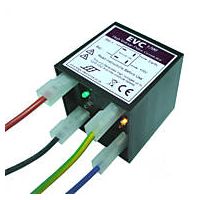
Technology came to the rescue. I found on ebay a most excellent toy, a 12 volt electric fence energiser that delivers 1,200 volts in 1 second intervals as well as an instant shock the moment you touch it. All I had to do was design the fence so that only the top was electrified (live). This was slightly complex since to make any sort of circuit, one needs a live and an earth. I ran a new earth line right across the top of the fence posts as the earth and then just above that (about an inch), I ran a clean live wire from the energiser, insulated from earth. Bottom line is that tonight, they finally all went into the house, but not before they had most enthusiastic sing-along as they tried in turn to do their usual trick of flying (jump-flapping?) up to the fence. Every second, the energiser blasted out a little wiggle of electricity and each time, the chicken’s feet got a little blast and they squawked (loudly) before jumping back down to the ground. Well, in the main that’s what happened but two of the birds jumped down wrong side, but we’ve “cured” them without resorting to 6-foot fencing which would look out of place in out trim and tidy English lawn.
Cheers, Callum!
May 22nd, 2009
Posted by
callum |
QRO |
no comments
I’m having a bit of fun currently, investigating putting a hot-spot above my house, using a 15dBi vertical antenna, so that we can connect 1,200 meters away from the Scout hut using a 24dBi Andrews Dish.
Using very high quality coax from my vertical antenna to a router in the shack is a very expensive option due to the very high losses at 2.4 GHz. We could use Ecoflex 15, but at £6 per meter and £9 for a connector, it’s a bit rich for a kids experiement.
Better bet is to site the router on top of the mast right next to the antenna in a waterproof box, using just a tiny pig-tail of coax from the antenna directly to the router. Of course, you need power to the router which might mean sending 240v utility power up the mast to the little PSU that comes with the router. Not a good option, having mains dripping off a mast.
How about cutting the low voltage line from the router’s PSU and extending it so that you have just DC running up the mast instead of mains? You can, but why not use the spare data pairs in the CAT 5 spec instead. These are pins 4 & 5 and 7 & 8. Connect the pairs together to lower the resistance (Ohms Law).
Ignore the colours that I have used in my project, this was to make fault finding easy in the future; blue being the negative and orange for positive - although in typical amateur radio style, I got these muddled up so now they’re the wrong way around and I wish I had just used the normal colours for the data now! Grrr.
I made up a 20 meter run of Cat 5 and injected 3.3 V DC from the little PSU that came with the router and pulled it out at the router end, as per the picture. Initially it failed miserably since the voltage drop was too low. The PSU was rated at 3.3V DC and 2A. Essentially, once the Router tried to suck any power down the line, the voltage dropped like a stone and the router wouldn’t boot up.
Throwing caution to the wind, I cut the 3.3V PSU off and substituted a 7V DC PSU which was lying about. My multimeter is currently on the boat, so I just did some rough mental calculations and guessed that the voltage would drop by around half, giving me maybe about 3.5 to 4 volts. Hopefully tolerable by a modern 3.3V device. I’ll measure it sometime, under load as well as no-load conditions.
Second caution to the wind was that when I cut the 7V cable off the donated PSU, I realised that the wires on the new device were not marked. I had no idea which was positive and which was negative. Not having a spare multimeter, I just hoped that getting the negative and positive the wrong way around wouldn’t concrete the damned thing. Luckily, Buffalo G54’s are two-a-penny these days on eBay and all my 2.4 GHz wireless experiments use these excellent devices. It wouldn’t be the first time that I had bricked one. Luck was in my favour tonight though and it all booted up just fine. Remarkable.
To sum up, if you are to do this, use pins 1, 2, 3 and 6 for the data and pins 4 & 5 and pins 7 & 8 for the DC as per diagram. Getting pins 1, 2, 3 and 6 wired up was a weird thing to do since I’ve always been paranoid to wire up every wire correctly. I suppose one ought to since in the future, someone might try and use your patch cable in a POE environment and it fails. Worse still, cabling a whole building and only testing pins 1, 2, 3 and 6!
Have fun.
Callum.
May 5th, 2009
Posted by
callum |
QRO |
no comments