I needed to mod my Yaesu FT-8800 recently. Be aware that the FT-8800 does not have have 6.25 kHz channel selection, the true PMR446 frequencies START the sequence at 446.062.50, which is channel 1 as in this table:
PMR 446 Channel Frequencies
-
446.00625 MHz
-
446.01875 MHz
-
446.03125 MHz
-
446.04375 MHz
-
446.05625 MHz
-
446.06875 MHz
-
446.08125 MHz
-
446.09375 MHz
So to listen for channel 1, you need to dial to the nearest you can get to, which would be 446.005.00. Channel 2 will be 446.020.00 etc. Obviously, set your rig to 5kHz channel selection (Menu #38).
 Ideally, you need 12.5 kHz channel selection starting from 446.006.25 which all Kenwood’s do (eg TS-2000 and Kenwood handies) however I don’t believe there’s a way to do this with FM only Yaesu Ham rigs.
Anyway, you want to mod yours? Here we go: Remove the screws on the top of the unit and lift it off, careful not to pull the loud speaker wires off.
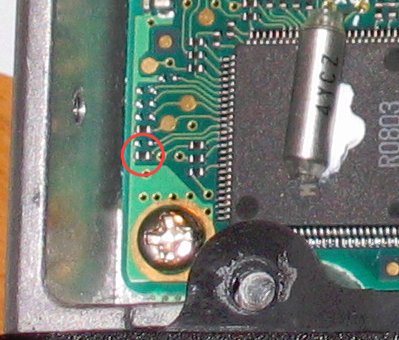
Find the bottom right Resistor/Diode I took this picture, because I couldn’t find one on the net that was the detailed enough for my poor eyes! Remove the component on the bottom left, as shown in the red circle. Unsoldering this is lots more difficult than you can imagine when your eyes are having an off-day. In fact, I got it off by scratching the soldering iron around tying to find the blasted thing. All of a sudden it was gone. You can tell I’m no hardware engineer! I have no idea where it went – it just dissapeared. Could it have melted? Dunno.
Anyway, re-assemble the radio and power it up. It goes through a factory reset power-up procedure and away you go with a brand new radio. Well, it worked for me!
Tips from others: Use a low wattage soldering iron and a ground strap. I didn’t do either!
73
Callum.
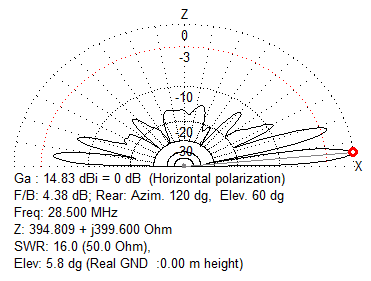 Apart from the noise factor (loops are quiet), the vertical seems to make a better impact on transmit more often than not for DX, unless I’m into NVIS or near NVIS (500 miles or so). Even then, up to 1,500 miles, the jury is out – either antenna can win. Beyond 1,500 miles the vertical seems to do a better job most of the time – not always, however my loops are very low to the ground, maximum height of 7 meters. On 40m, I would say the vertical is a better antenna to have almost all of the time unless you need NVIS for local copying – and with the sun spot cycle as it is, you won’t get this for a while yet!
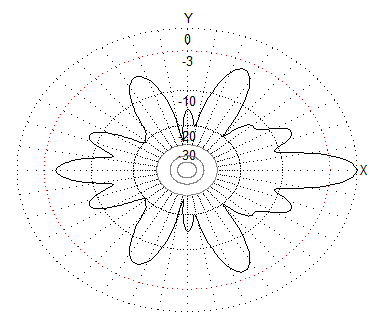 Now.. This is a very different animal to the Skyloops that most people build. If you want a pile-up generator, this is the animal to have. It fundamentally, takes all your RF energy and pancakes it low to the ground in various star shapes. Very Of course, you will sometimes null out the station you want but you could get really clever and change feedpoints with relays. But ignoring the clever engineering, this has changed my mind as to the effectiveness of a high skyloop.